Thursday, December 17, 2015

Obama at the Gate

I am watching the Obama Arising with interest. It is really interesting to reflect back on my initial musings about the potential of the Obama Administration by completing this post which I started writing in 2008. Much of what  I feared and some of what I hoped has manifested itself. This has not been surprising or unexpected. But, again, often, disappointing and sometimes encouraging.

 As I watched the Obamamania sweep the progressive political community and the reactive dominant community I saw two things. Each is an aspect of an experience that informs my worldview. While not wholly or totally the same but similar to the situations that I will share.

First, Barack Obama's election reminded me of two earlier electoral political events. The earliest, and possibly the most similar, example was the election of Harold Washington. The other was the election of Nelson Mandela. Both these events had similarities to the election of Barack Obama.

There were several features of the election of Harold Washington that foreshadowed or reflected the Barack Obama experience. One of the similarities between Barack Obama's election and Harold Washington's election was their status as a "first." Harold Washington was the first African-American elected as mayor of Chicago. Of course, Barack Obama was the first African-American elected as President of the United states.

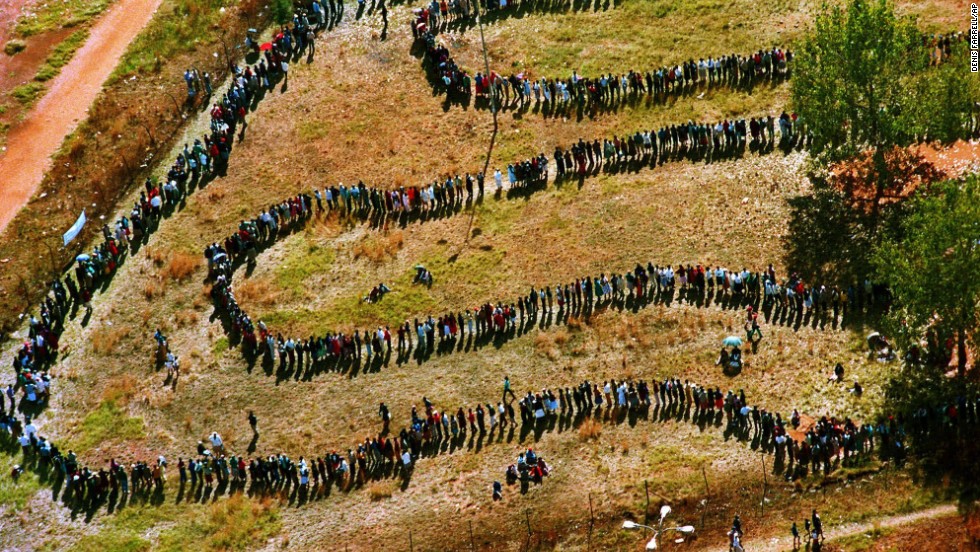
I remember the actual election day for Harold Washington. There was a huge turnout of voters. This was possibly one of the highest voter turnout of African Americans since the founding of Chicago by the fur trader of African descent, Jean Baptiste DuSable. Reflecting on that day evokes images of elderly voters leaning on canes standing in line with voters on hospital gurneys pulling  hospital equipment along with them. There were stories of long lines and long waits, polling places that ran out of ballots and hours that were extended to accommodate voter turnout.

We saw similar pictures of the response to Nelson Mandela's election in South Africa. There were the same, or similar, long lines with elderly voters leaning on canes, voters discharged from hospitals leaning on canes and lying on gurneys, first-time young voters and, ultimately, one time only voters. The fact that the election held promise and reflected a vision of equity and inclusion brought out and engaged sectors of the electorate that had been disengaged and disenfranchised with the hope, and expectation, that their vote would make a difference. One significant difference between Chicago, a municipal election, and South Africa, a national election, was that it was the first time that many Mandela supporters were able to vote; whereas Chicago voters felt for the first time that their vote could matter.

Barack Obama's election brought a similar type of energy for voters of African descent across the nation. Partly there was the notion that he (Barack Obama) could actually win. Based on the essentialist notions that are a basic premise of race certain expectations and assumptions regarding values were a major motivating factor. In all three cases the promise reflected by electoral promise was stunted by the institutional demands of white supremacy. The need to maintain the basic social and economic structures that reflects the European onslaught that began in 1492 constrains and contains the possibility of change.


Creative Commons License

This work is licensed under a
Creative Commons Attribution-Noncommercial-Share Alike 3.0 United States License.

Monday, February 14, 2011

Valentine's Day -Love, Lust and Enlightenment

It is that time of year when the commecial demand for consumerism captivates and overtakes the spiritual connection that occurs when the vibratory fequency of two beings harmonize.

I have long attempted to differentiate the term "love" from its fraternal and its physical manifestations. We use the same word to describe the sexual experience and the filial experience. During a sermon on 'desire' a new way of articulating the connection and the contradiction occurred to me. The distinction in reflected in the Greek language with the terms "agape" or friendship and "eros" or eroticism.

Love is caring. Desire is wanting. One of the simplest ways to contrast the two experiences is to look at what we mean when we say we "love" a parent, a sibling or a child versus what we mean when we speak of "love" regarding a mate or sexual partner. Caring and wanting are not mutually exclusive but each has a distinct manifestation in its own domain. Caring connects with wanting in terms of memory in the Agape domain. Desire connects with caring in terms of romance in the Eros domain.

Love is light. Desire is heat. Love creates the desire to be responsive to the needs of the other. This means we look for what we can do or how we can interact and relate to them. This seeking is analagous with light. Desire is heat. Desire is often described with the metaphor of fire. This refelects the tendency for desire to consume us emotionally and stimulate us physically resulting in physical heat and emotional heat. Love and desire joined and connected offer both heat and light.

Love is attachment. Desire is attraction. Love results in our connection with another even when apart. This connection is an important component of fidelity. Desire is attraction. Desire results in our moving towards our target and seeking the object of our attraction. It can be fleeting, impermanent and transitory but powerful nonetheless. This duality is often a source of confusion due to the imprecision of our use of terminology related to the concept "love." When men are attracted to women based on desire it does not mean they will feel attached to them but often this is not the case due to their lack of interest or understanding of the person. It mght take me a few more minutes to clearly articulate this analogy.

Love is contentment. Desire is yearning. These two descriptions are in line with the same distinction of the agape and eros domains. Caring, light, attachment all contribute to the contentment of agape love. Wanting, heat, attraction contributes to the yearning of desire. What we must do is to understand that either domain has both its strengths and its weaknesses. We must choos wisely for our own emotionand and spiritual health and that of the one we love.


Creative Commons License
This work is licensed under a Creative Commons Attribution-Noncommercial-Share Alike 3.0 United States License.-